Mostrando las entradas con la etiqueta SEO Tricks & Tips. Mostrar todas las entradas

sábado, 22 de julio de 2017

What are the best online or software ranking tools for an SEO/Web agency?

Serpstat is already a leading cloud rank tracker. But we added great updates recendtly, so you now you can take full advantage from our:
Complete research of SERP with advanced analytics
Get all the top results for keywords you’ve selected. Serpstat has developed the ultimate algorithm that analyzes SERPs and saves data about top-100 domains for every keyword.
Global city-based tracking
Find out exactly how your keywords are ranking in Google and Yandex (Yahoo! and Bing will be soon) in any city, country or language you specify.
Daily results
Track an unlimited number of keywords on a daily basis. Get the freshest data and keep an eye on your competitors’ web performance.
If you start monitoring a keyword like "buy a cellphone" you will see positions of all 100 domains for this keywords, regardless of what domain you monitor. Of course you can chose to highlight your own domain and domains of your closest competitors, but you'll still get complete data for each keyword.
Monitor How The Positions Of Your Competitors Are Changing
Serpstat shows how the positions of your competitors are changing and let's you know when a new competitor appears or someone gets pushed out of the top-100 positions.
Monitoring positions of your competitors is an important part of using rank tracking. With traditional rank trackers you have to add each competitor to your project if you want to know how their positions are changing:
Serpstat constantly shows all of the ranking changes of your competitors. You can see which domains improved or tanked their positions, see and track the arrival of new competitors as well those who are no longer rank for your target keywords.
Independent statistics for groups of search queries
Track competition dynamics for groups of phrases, instead of for individual keywords. Only explore competitors in a specific, narrow niche.
For example, here's a list of domains that Ebay competes with for all of the keywords that I added to the tracking project.
And this is a list of competitors within a keyword group. I created a keyword group named "Style" where only the keywords that refer to clothes, accessories, shoes are present.
Market Share Analysis
Serpstat is the only tool that allows you to analyze the size of your and your competitor's market shares.
Market share distribution analysis is a very useful feature for both, marketers and SEO specialists. You can use it for monitoring your own progress within a niche and compare it to the progress of your competitors, to see if your optimization really brings more clients to your website.
Another awesome use for this feature is market analysis. If you're thinking of joining a new market, it's best to start with analysis, so you know what websites are in the lead and how big of a market share you'll be able to grab.
To use this feature you need to create keyword groups based on the type of products, for example "cell phones" and "laptops" and analyze these groups separately. For each group of phrases you will have the list of top-100 domains along with the size of a market share for these domain. Your domain may be the biggest in cell phones but lack in laptops:
By monitoring the size of a market share, SEO and Marketing specialists can see how website is improving, regardless of the ranking. Market share analysis accounts for search volume and CTR, which is more useful than just looking at website's position for a certain keyword. Improving visibility for 100 low-volume keywords may result in expanding your market share more than ranking for a few keywords with high search volume.
Historical Rank Tracking Data From All Existing Projects
If someone was tracking a keyword that you've added to your project in the same region as you, we will show you the historical data from their project, for free!
Regular rank tracking services show the data from your project only. While Serpstat provides previously saved positions data for all keywords that were previously monitored.
If the keyword you add to your project was monitored previously in the same region, Serpstat will show you the data we have on that keyword.
For example, a user has been tracking his position for the keyword "laptops" in Florida for the previous 10 day, and you want to start tracking your position for this same keyword in Florida today, you'll get the top 100 search results history for "laptops" over the last 10 days as a bonus.
SERP by phrase, Storm, and Snippets
Storm — this graph shows how the rankings for the tracked keyword changed in the Google top-100 organic results regarding the previous date. Thus you can see how active the Google SERP was changing from the moment you started tracking this keyword.
SERP by phrase chart shows how Google's top-10 was changing for the tracked keyword.
Use this graph for competitive analysis. You can even delete the competitors you are not interested in and leave the necessary ones. Just tick the box.
SERP Snippets — here you can check how your SERP snippets looked like at the different days (according to the schedule of rank tracking).
Unlimited users at no additional cost
Share your project with team members and give your clients or boss their own login for reporting. Make the process of reporting easier and automatic.
Prices
If you’re a website owner or an enterprise business, we just have the right plan for you - Plans & Pricing — Serpstat - starting from just $19/mo you can monitor up to 200 keywords in your project and use all Serpstat modules - Competitors and Keyword Research tools, Backlink tool, Ad research, and Site Audit. For the ultimate global rank tracker with all SEO tools under one roof that the deal you were looking for.

How can I do keyword research for SEO?

Congratulations for asking the right question! Keyword Research should be your first step when it comes to running a successful SEO campaign.
You can’t win a battle if you don’t know your enemy ..
Begin with brainstorming, then research those terms with some great tools. There are techniques that you can utilize to narrow down the long list of terms that you will need to reach your target audience. A few are listed below:
Tip 1. List all the Important Topics Related to Your Business
You know your business better than anyone. Write down your elevator pitch: what is your business about and who is your target audience?
Begin by listing topics that are related to your business: If you are just starting out, try to think about what your site is and what it might grow to be. If you are a tech-savvy blogger, make sure that your list will include topics related to technologies you often blog about.
If you need inspiration, put yourself in the shoes of your audience. A good trick is to pretend that you are selling your business to your best friend. What’s going to catch their interest? Think about the things that they would want to read.
Tip 2. Think of all Possible Keywords That you can put Into Your Topic Lists.
Think of your topic lists as empty buckets that you need to fill with keywords. This part requires careful thinking and brainstorming. There are a lot of keywords that you can use for a certain topic. However, you need to choose the keywords or keyword phrases carefully to help your rank in search engine results pages, or SERP.
For example, your topic is “online English tutorial.” Think about the different keywords or phrases that people might use to search for that subject. It might include:
  • English tutorial online
  • Where to enroll for online English tutorial
  • Best online English tutors
  • English tutorial tools
These are just some of the possible things that people may search online. Keep in mind that you do not have to list all the keywords and keyword phrases. You are simply compiling many options from which to filter the best one.
Tip 3. Use Keyword Research Tool if Possible
If you want to make your work easier, invest in an effective keyword research tool. Of course, you can always do it manually. But, using a keyword research tool will save you tons of time and effort. It will make the process easier, faster, and more effective because it can produce results in just a few clicks.
Just login, type in your topic and it will do the rest for you. Some keyword research tools will even give you the option to widen your search option by including related searches, Google suggestions, and other synonyms coming from Google Adwords.
Below is an example of a keyword research results for the topic “online English tutorial” using one of my favorite Keyword research and analysis tools.
This is one of my favorite tools. If the keyword is “green” for difficulty, then there’s a good chance that you can rank for it easily. In my experience, it takes about 3 months to rank for such keywords.
Tip 4. Refine Your List
Once you already have an extensive list of keywords and keyword phrases, refine it. Make sure that you include suggested keywords. If you are using Google Keyword Planner, you need to know that the tool gives high priority to Google ads. Therefore, it will load keywords from Ad group first.
If you want to look for suggested or related keywords, click on the Keyword ideas. Suggested keywords are important as they will give you a clearer insight into what exact terms your target audience are using. Refining your list means looking after the relevance of the keywords and keyword phrases to your topic.
Make sure that your keywords powerfully describe the topic or are relevant to your landing page. If the keywords are related to your topic but are not directly linked to the subject of your landing page, just create a new landing page and write new content that includes the keyword.
After following all these simple tips, voila! You now have your list of keywords or keyword phrases and now on your way to gaining short and long-term traffic from focused keyword usage. These keywords will be your guide to creating content that will be beneficial to your business or website.
Also, keep in mind to review your keywords as often as you can. Once you have gained more authority in SERP, you will find that you may add more keywords to your lists. Adding new keywords to your list will give you more opportunity to grow in other areas while you maintain your present rank from other successful content.

miércoles, 19 de julio de 2017

How do I better use CPC? What are some innovative suggestions?

As a premium Keyword and Competitor Research tool, we at Sersptat compiled use-cases of our clients among leading SEO/PPC agencies. Here’s how you can effectively run your PPC campaigns much more effectively, spend less time and money on research and gain insights into market:
#1. Research All of your Competitors Paid Keywords:
  • Enter your competitor's domain to the search bar of Serpstat, choose the database and click on "Search."
  • Go to "Domain Analysis" module, then "PPC Research" and finally click on "Keywords."
  • Export this report and analyze it.
  • Pay particular attention to "Keyword" column.
Here are all the keywords your competitor is displayed for in contextual advertising. It's a ready-to-use list of keywords for launching your PPC campaign. Or you can choose another tactic and exclude these keywords from your list to avoid competition.
#2 Find out what ads your competitor is using
Writing ads seems quite simple, but inspiration doesn't have a schedule. This method will help you to find some ads' ideas when you run out of inspiration. As in the previous method, we'll borrow ideas from our competitors.
  • To do this switch from "Keywords" to "Ads examples" feature in PPC Research module.
Export the gained report.
Pay attention to "Title" and "Text" columns.
#3 What landing pages does your competitor align with PPC ads?
A landing page is an important part of successful PPC campaign. Research your competitors, analyze what landing pages they create and use. It will help you to learn which strategies work and which ones don't. Take several minutes a day to track the landing pages of your competitors not to miss the changes they make. Analyze this changes, why your rival changed some parts of his landing page and how these changes affect the conversions.
  • Same as the previous method, we need "Ads" feature of PPC analysis module. If you've already exported this report in the method #2, just reopen it.
  • Now, look at the "URL" column.
Now you see what strategies your competitors use. Use this intel to modify your PPC campaign, ask your front-end developer and designer to create new landing pages with clear and tried CTAs.
#4 How to find missing keywords
Don’t bother thinking of new keywords and spend time and money on their research, chances are, your successful competitors already done the leg work for you. Just borrow some from our competitors ;) So just compare the keywords you use with theirs:
  • Go to "Domain vs Domain" feature, which is in the PPC research module as well.
  • Type your domain to the first box and the domains of your 2 direct competitors to the other ones.
  • Analyze the data you get and create a list of your missing keywords:
  • that are unique for competitor #1;
  • that are unique for competitor #2;
  • that are common for both of your competitors.
Use these keywords to expand your semantic core. But what to do if your keywords core (whole range of keywords that you use) already bigger than your rivals, and there is nothing to borrow from them?
#5 How to get even more keywords
If you already use more keywords than your rivals, you may wonder where to get ideas for new PPC campaigns. You can try to brainstorm or spend hours perusing different blogs and forums or just use this method based on combining of several reports:
  • Type a high-volume keyword, which is relevant to your website to the tools search box. If you sell laptops, enter "laptop", for example:
  • Then export the following reports one by one:
  • Keyword research → SEO Research → Keyword selection;
  • Keyword research → SEO Research → Cluster research;
  • Keyword research → SEO Research → Search Suggestions;
  • Keyword research → PPC Research → Keywords.
  • After exporting all of these reports, gather them into one file
So, you’ll have a huge file full of niche keywords. Group these keywords, clean up all irrelevant ones. An increase in the number of keywords will cause the traffic growth. So be ready to pony up extra money on your PPC campaigns.
All these methods are widely known, time-honored and used by most of PPC experts. You can start using them with no risk.

lunes, 10 de julio de 2017

The 9 best free search keywords

The 9 best free search tools

posicionamiento web palabras clave


The search for keywords or keywords, represents a fundamental part of any strategy of Inbound Marketing. Locating the keywords that represent an opportunity and their respective long queues offers us a game board in which to develop, later, our favorite tactics in the generation of content and also to know which keywords should not be used in your positioning.

Internet is full of these tools, there are all kinds of alternatives: online and desktop applications, paid and free ...

To make this process as easy as possible, we have collected here the 7 most effective free online tools to search for keywords. You probably find that there are some well-known ones like Semrush or Wordtracker. We have left only the ones that are 100% free and yield results in Spanish language.

1. Keywordtool.io

This tool is very useful if you are looking for ideas to extend the long-tail our positioning opportunity on a main keyword.
posicionamiento web

It has a language selector, which allows us to better choose the search results (you can do the test between google.es and google.com.mx for any term). It also allows you to navigate between different search engines: youtube, bing, app store and google itself.

Keywords positioning web

The results of keywordtool.io are listed by blocks and use the autocomplete function of google to offer you terms that users are looking for assiduously and that, therefore, are always interesting to know in the face of our planning.


A strong point of this online software is that it adds you long-tail options using prefixes, suffixes and interfixes of our search, which greatly enriches the semantic aspect. In this sense, it also detects genres and plurals.

2. Ubberguggest.org

In the same line as keywordtool.io we find another classic SEO analysis: ubersuggest.org.

Web position keywordsThis platform uses the Google Suggest function in the same way, although in this case the only difference is the sampling of the information, which appears in vertical format and allows you to select the most interesting and then easily obtain a copy & paste that Take us to our favorite tool for predicting and observing traffic by keyword.

We have noticed that the results are different from other similar applications, so we recommend that you use several to test results and know if it is a good idea to use one or another long-tail keyword before you start typing.

3. KW Finder

Keyword positioning keywords

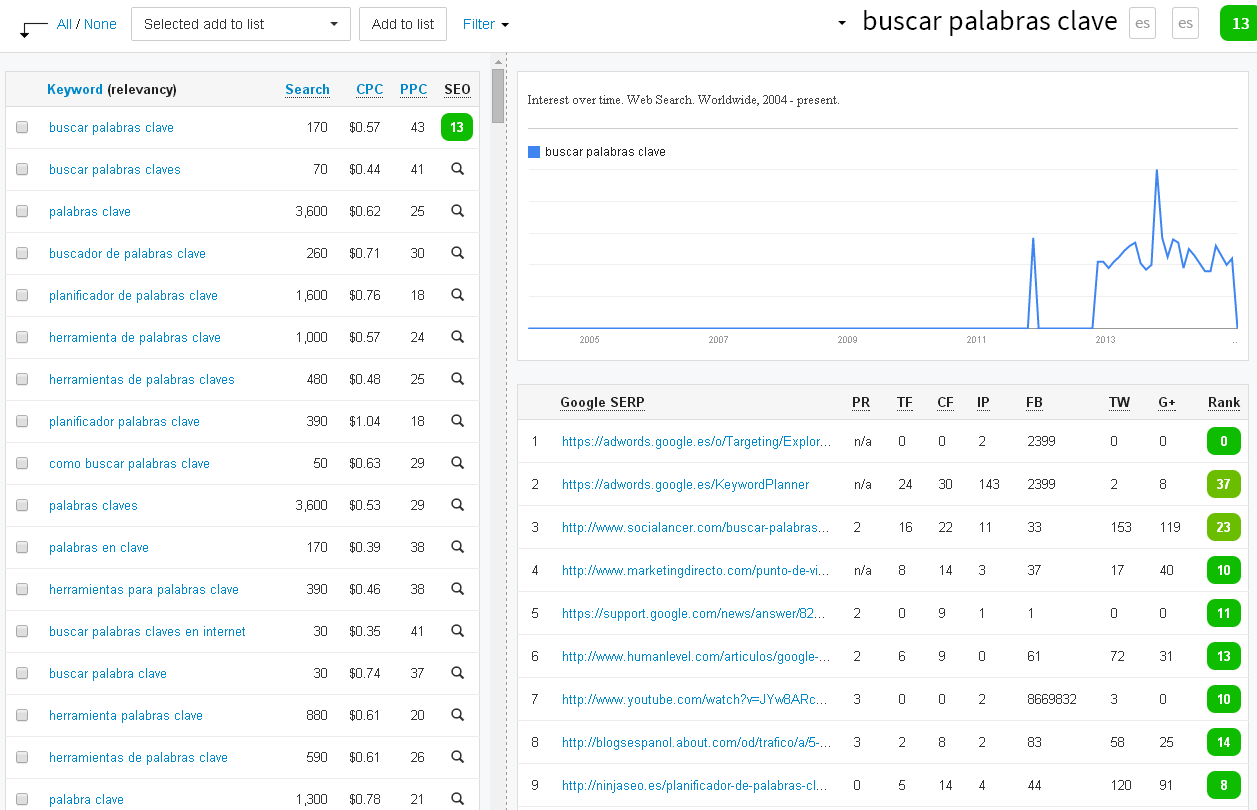
With keyword finder we will be able to obtain, free of charge and immediately, a dashboard about any term that will help us a lot to make important decisions about our selection of keywords.

With each search we can see:

A list of suggestions regarding our search with estimated volume and price in CPC campaigns, as well as competition in the same channel.
The main competitors with which we will have to fight (10 first results of the SERP). Here we can see the Page Rank and Trust Rank of each of them.
An evolution in search trends.

posicionamiento web palabras clave


A note that goes a little unnoticed in the search result is the number of shares that each organic result has in the main social networks: twitter, facebook, google plus ... Which also gives us a clue about the potentiality in the capacity of viralization And dissemination of the content that we generate.

4. Google Keyword Planner Tool

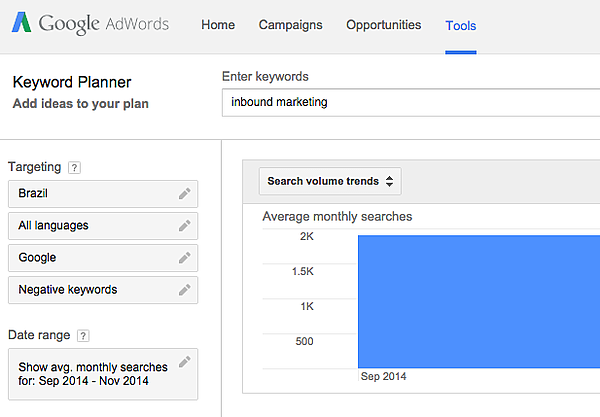
The most widely used of all, by contrast, offers us a different view to the others, since it does not use the autocomplete function but it looks for a much smarter connection (sometimes, perhaps in excess).

posicionamiento web palabras clave

With this tool we can get ideas for new keywords that are grouped according to the theme or context of search, facilitating navigation.

We recommend that you always have this platform open in a tab to be able to use its function "get volume of searches" once you have collected information with all the tools available, that way you will close the circle of investigation taking into account the wise opinion of Google.

5. Smallword Tools Keyword Suggestion Tool

In your Small SEO Tools web page the first thing you will find is a search box and a "check" button (be careful not to click on the banner just below that box, since it is a covert banner that reads: " Get free backlinks ").

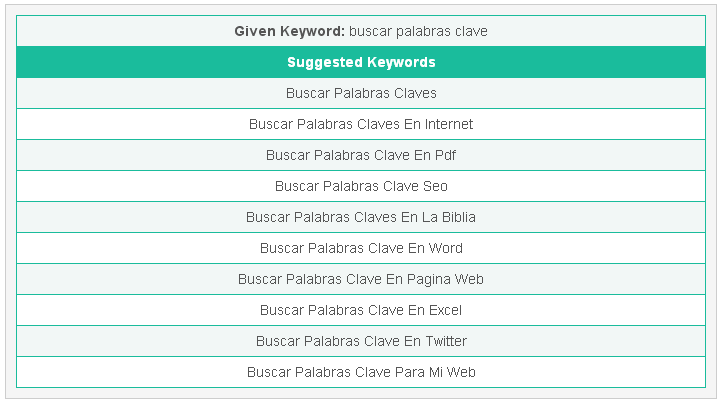
The results of this tool are very surprising, since what we are proposing are directly results that could well be the titles of the post on the subject sought, here you can see an example with our star request: "search keywords".

posicionamiento web palabras clave

Except for the surprising result of "searching keywords in the bible", all others are chosen as the most interesting to carry out a content strategy. Interesting!

6. TinySuggest

Web positioning keywordsCredit by Tiny Rocket Lab, tinysuggest.com uses the same method as the Small SEO Tools tool to give us a selection of more relevant results based on our search.

In addition, we can directly download this listing in an editable format to take it to our favorite keyword analysis tool in just a few clicks.

7. Soovle

To finish and as a curiosity, we leave a link to the unknown soovle.com.
posicionamiento web palabras clave
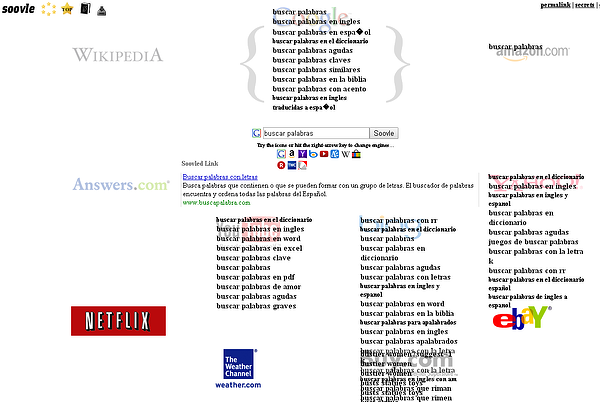
In this page we can obtain, in real time, long-tail keywords in different search engines of some of the most well-known pages in the world, like youtube.com, wikipedia.org or amazon.com. Although it is not very optimized for the Spanish language or works with portals that have no presence in Spanish-speaking countries (such as buy.com or netflix.com), it is very curious to check the autocompletion functions of these engines to see trends.

8. Google Keyword Tool

Google Keyword Tool
posicionamiento web palabras clave

Despite having changed the design of this tool in recent years, Google Keyword Tool is a very interesting tool to estimate the traffic of some keywords and keywords in which we are thinking to add the most appropriate in our content.

This tool helps us produce large-scale content and get good opportunities for links. In addition, it also contributes to the position of the brand in the search engines. For these reasons, we recommend using it often.

9. Google Auto Suggest

posicionamiento web palabras clave

This tool is not official, but I could tell you that it is incredibly useful! It can open your horizons to get better keywords for your content. If you do not know how to get these keywords, now it's very easy, go to Google, start writing anything and a list of words just below the search engine.

And that's it! Google auto suggest is a very interesting resource to show you which are the most searched words or phrases in Google that you can use. A very simple way to get information to start creating your content.

Do you know any more interesting tools? Thread them down!


Best SEO Practices to Dominate In 2017


Optimize for Rich Answers

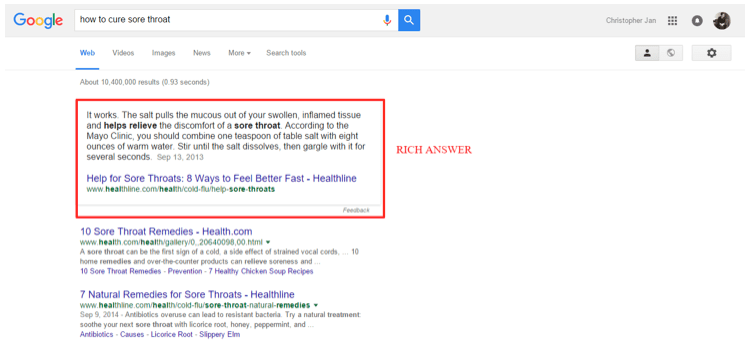
Although aiming for the top positions in Google search for your target keywords is still important, it's now time to optimize for other Rich Answers too. These are results that appear towards the top organic search results.
Google answer box
According to Stone Temple Consulting, rich answers appear on 19.45% of Google search results out of the 850,000 keyword queries used to trigger these.
The percentage may not be as high at the moment – most of the rich answers appear on search queries for song lyrics. However, there is good cause to believe that its number will only increase in the future. Since Google has made its intention of providing value to its users clear, rich answers provide the most relevant information based on the search query.
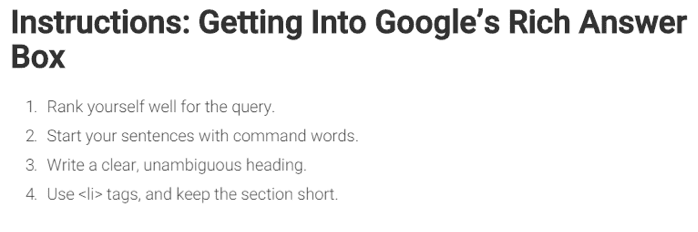
How to rank for rich answers: Northcutt Consulting Group has broken down the most relevant factors for ranking on rich answers.
Google answer box
The first point is important. Optimizing for rich answers requires you to optimizing for your target keyword as well. Getting your page to rank on the first page of search engines will increase your chances of getting into the rich answers box.
The post at Northcutt is not the definitive way to rank for the rich answer box since we are dealing with Google algorithm here, after all. Its algorithm can never be reduced to an exact science consider of how unstable it is. However, the post should give you a good idea of how you can increase your chances of getting your page on top the top of search results.

Review Google's other featured content

Keep an eye on the Mozcast Google Feature review for other types of content that features within Google results. Rich Answers are referenced here as 'featured snippets'.  A similar feature is 'Related questions', showing how our articles should try to cover these questions.  Images and videos are other better known ways of gaining cut-through in the SERPs for some search terms - check which are important for your industry.
Googles Featured content - Mozcast

Improve user engagement

Ever since, marketers have always speculated user engagement as a possible ranking factor. This covers the average time on site, bounce rate, pogo sticking, and others.
For conversion, it is a proven factor that determines the effectiveness of page elements that contribute to the chances of visitors committing to your call to action.
However, what makes this factors difficult to measure in search engines is the lack of data supporting it.
User engagement is too indirect an influence on search rankings. Nonetheless, it is something that all website owners need to optimize if they are serious about getting more out of their SEO efforts.
“User engagement is just as important as any other on-site element in this day and age,” says Matt Banner of OnBlastBlog.com. “If a visitor enjoys your website, they'll stay on your site longer, visit more pages, help contribute to a lower bounce rate for your site overall, and most likely become a returning visitor.
“All of these positive elements factored together combine for a type of website that Google wants to rank highly in the search engines. If the user finds the website beneficial, you can bet Google will as well.”
How to rank with the help of user engagement: To help improve your site performance, in the long run, using user engagement as a factor, you may need to use tools to gain insight on how much interaction your site pages is getting from visitors.
Heatmapping quickly comes to mind when thinking of user engagement. The idea here is that the more clicks a page accumulates from its links, the more interaction it has with users.
Tools like SumoMe Heat Maps and CrazyEgg are great ways to break down the number of clicks made by users on your tracked site pages. From here, you can see which links are clicked the most and least. You can then optimize your site by improving your CTA links and buttons based on the accumulated data.
To analyze visitor engagement with your site pages, the SumoMe Content Analytics is an extremely helpful tool in looking how many of your site visitors scroll down until the very end of the page. From the data, you can also find out which part of your page where 50% of your visitors leave. Determine which elements of your site pages serve as obstacles that prevent visitors from scrolling down your page and optimize your site as you see fit.

Mobile App Optimization

The mobile market is big. So big, in fact, that Google is still figuring out how to provide mobile users with a better search experience.
The so-called 'Mobilegeddon' or more accurately Google's Mobile-friendly update is a step towards this direction, as site owners are encouraged to develop mobile or responsive designs to increase the site’s loading speed on mobile devices. A faster loading site means more chances to retain visitors.
US mobile search ad spending
While there is also interest in spending on mobile ads as the figures from eMarketer show, Google will soon take a more crucial role in delivering content to mobile users, starting with app store optimization.
"ASO (App Store Optimization) will be the next gen SEO in 2016,” says Rob Lons of performance SEO services RankPay. “If you look at the rise of mobile use and how much paid ad dollars are being spent each year, you can see the huge demand and rush to reach people on their mobile devices.”
More importantly, the App Indexing is the latest development in search results that can make an impact in how your site pages will rank for your target keywords.
Originally, apps are indexed on App Store and Google Play, not on Google search. This made it much more complicated for Google to streamline its search capabilities – marketers will have to optimize on both app stores instead of just on Google organic.
Through App Index, apps are now indexed on Google search. The search ranking of apps falls under the App Pack or Deep Link category.
Below is a comparison of app rankings on mobile search. The image is taken from this extensive article about App Indexing at Search Engine Land.
app packsApp Indexing brings in millions of additional search results for search queries on Google mobile search. This means that webpages ranking for their target keyword will have to fight of million of app pages that are optimized for their keyword as well. As if the competition is not stiff enough!
How to rank for mobile search results after App Indexing: Instead of fending off app results for your target keyword, why not consider developing an app for your business?
If you do not have an app for your site yet, consider building one to take advantage of the benefits App Indexing brings, in particular, its deep links.
Choosing the best mobile app development services is just half the battle. The other half involves developing a solid foundation for your mobile app and the goal you wish to achieve in developing it. Identifying both should provide you a more strategic approach with your mobile app in line with meeting your online goals.
Once you have a mobile app in place, you can begin implementing the steps on how to get your deep app screen indexed on search results by referring to this straightforward documentation from Google. The process can be arduous for non-developers, so you may want to ask for help from an expert regarding this.

Google’s new search quality guidelines

Google released their latest 160-page search quality guidelines. The last previous published was the abridged version two years ago that was a reaction to the leaked versions from 2008, 2011, and 2012 (notwithstanding the 2014 version) for the purpose of transparency.
As expected, the published document is far from the finished product.
"This is not the final version of our rater guidelines,” says Google Senior Program Manager and Search Growth & Analysis Mimi Underwood in this post. “ The guidelines will continue to evolve as search, and how people use it, changes. We won’t be updating the public document with every change, but we will try to publish big changes to the guidelines periodically."
You can download your copy of the search quality guidelines from the link above.
Below are some key takeaways from the guidelines:
  • High-quality standards are set on Your Money or Your Life (YMYL) pages - These pages include shopping transaction pages, financial information pages, medical information pages, legal information pages, and similar sites. The reason for the placing high-quality standards on these pages is how these can affect "the future happiness, health, or wealth of users." Low-quality YMYL pages can negatively impact one's happiness and health, so it is important to build useful pages under this umbrella term.
  • The value placed on Expertise/Authoritativeness/Trustworthiness (E-A-T) –high-quality content must come from E-A-T sources. E-A-T is built by acquiring accreditation if necessary. For instance, medical information found online must come from accredited medical persons or organizations. Corollary, first-hand experience counts as a form of expertise. For example, a user sharing how he survived cancer is a form of expertise.
  • Needs Met guidelines cater to mobile usability – Web pages are gauged by how they are optimized for mobile viewing and the satisfaction they provide to users about the search query. The guidelines are loosely divided into five ratings (from Fully Meets to Fails to Meet) – a website can fall between the assigned ratings if needed be.
What to make out of these quality guidelines: All signs point to improving the mobile usability of your site (as already mentioned above), as well as establishing yourself as an influence within your niche. By building your expertise and knowledge in your industry, you can establish your authority as a subject matter expert, thus earning the trust of your audience.